

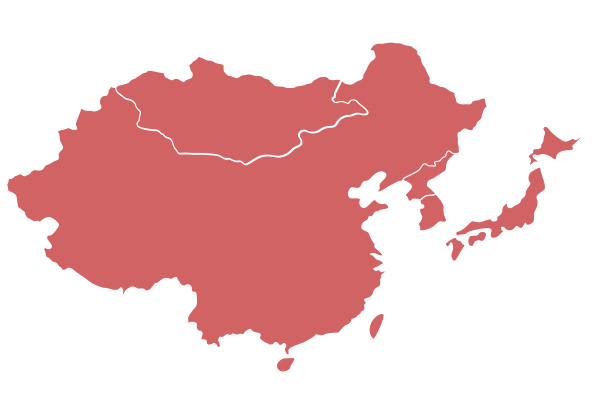
In all seven countries in East Asia, national ID cards are the primary legal identity document that is used as proof of identity and legal residency. The National ID also provides access to a range of public and private services such as banking, health insurance, social security benefits, driver’s license, employment, marriages registration, voting, taxation, and school enrollment. These ID cards, mandatory for citizens or residents, can only be applied for upon reaching the approved age, ranging between 11 years (China, Hong Kong), 14 years (Taiwan), 16 years (Mongolia), and 17 years old (North Korea, South Korea).[1]
Table 1: Types of National ID Cards in the East Asia Sub-Region
| Types of National ID Cards | Countries |
| National ID Cards | Taiwan, Hong Kong, Japan |
| Resident Registration or Identity Cards | South Korea, China |
| Citizen ID Cards | Mongolia, North Korea |
Unlike other sub-regions that rely primarily on birth certificates, East Asia is characterized by the use of family or household registration records, which serve as prerequisite documents for applying for national ID cards in all seven countries of the sub-region. One common feature across China, Japan, Taiwan, and South Korea is the linkage between birth registration and the household registration system, which serve as the basis for establishing permanent residency status and gaining access to public services from education to healthcare. China’s hukou household registration system plays a central role in proof of legal identity documents as the hukou books are mandatory documents needed to apply for both birth certificates and Resident Identity Cards.[2] In South Korea, they have hospital issued Birth Certificates but they also have the Basic Certificate and Family Relations Certificate – all three documents together act as foundational legal identity documents that verifies both identity and proof of South Korean citizenship.[3] In Taiwan, only nationals with household registration are eligible to apply for National ID Card which grants individuals the right to reside, work, and vote.[4]
In countries without a household registration system such as Hong Kong, individuals applying for a permanent HKID need to prove their ‘right to abode’ through a certificate.[5] In North Korea, citizens’ ID cards are issued to all citizens. However, for new ID cards issued from 2019 onwards citizens are required to submit blood test results and provide biometric data including photos and fingerprints.[6] Similarly in Mongolia, to apply for the citizen ID card, citizens must present birth certificates, passports, and biometric data.[7]
In four out of the seven countries (Hong Kong, Japan, Mongolia, South Korea), national ID cards serve as proof of identity and legal residence status as opposed to proof of citizenship – as they have designated other legal identity documents such as household registration books, birth certificates or passports to prove citizenship. In contrast, in China, North Korea, and Taiwan, the ID cards constitute citizenship.
Table 2: Comparison of the function of national ID cards in countries in East Asia
| Countries where national ID cards constitute citizenship | China, North Korea, and Taiwan |
| Countries where national ID cards serve as proof of identity and legal residence status but not citizenship | Hong Kong, Japan, Mongolia, South Korea |
Countries in the East Asia sub-region have different approaches to providing non-citizens access to national ID cards. In Hong Kong, Japan, South Korea, and Taiwan, foreign nationals may apply for alternative versions of these ID cards, by presenting documentation about their legal residence status, through the non-permanent HKID, My Number Card, Foreign Residence Cards, and Alien Residence Certificate, respectively.[8] Although this is available for foreign nationals, it is more challenging for stateless persons who typically do not possess legal identity and other documentation, to qualify and thus apply for these ID cards. In the remaining three countries, China, Mongolia, and North Korea, there is no known way for both non-citizens and stateless persons to acquire legal identity documents except through acquisition of citizenship via naturalization.
Table 3: Primary Legal Identity Document and the Documents Needed to Apply across East Asia
| Country | Primary Legal Identity Document | Documents Needed | Does legal identity serve as proof of citizenship |
| China | Resident Identity Card (RIC) | Registration form, hukou registration book.[9] | Yes, only citizens or naturalized foreign nationals with legal residence status are eligible to apply for RIC.[10] |
| Hong Kong | Permanent and Non-Permanent Hong Kong Identity Card (HKID) | For permanent HKID a certificate to prove right to abode while for non-permanent HKID, passports, proof of residency status through a valid employment, investment, dependent, or student visa, birth certificate, and previously issued identity card.[11] | No, a HKID is framed more as proof of identity and legal residence status rather than proof of citizenship since it is accessible to non-citizens. |
| Japan | My Number Card | Can apply using unique individual number that is assigned through the My Number Notice. [12] | No, this ID card is issued to citizens and foreign residents who are on the resident registry.[13] |
| Mongolia | Citizen ID card | Birth certificate, passport, and an application form. [14] | No, even though it is only available to Mongolian citizens, the passport or birth certificate are the primary documents certifying citizenship.[15] |
| North Korea | Citizen ID card | Personal registration data, blood tests, and biometric data (photos and fingerprints).[16] | Yes, it is one of the two acceptable legal identity documents confirming citizenship besides the birth certificate.[17] |
| South Korea | Resident Registration Card | For citizens: application form, a photo, and fingerprint data; for foreign nationals additional documents are needed: passport and documents proving place of residence.[18] | No, the Basic Certificate, along with the Family Relations Certificate are what verifies both legal identity and proof of citizenship. [19] |
| Taiwan | National ID Card | Photo, original household registration book, and a personal seal.[20] | Yes, holding the card constitutes having Taiwanese nationality and an established household registration.[21] |